Rothko's Two Best Known Artworks |
||
Mark Rothko, No. 14, 1960. Oil on canvas, 9'6" x 8'9". San Francisco Museum of Modern Art, San Francisco (Helen Crocker Russell Fund Purchase)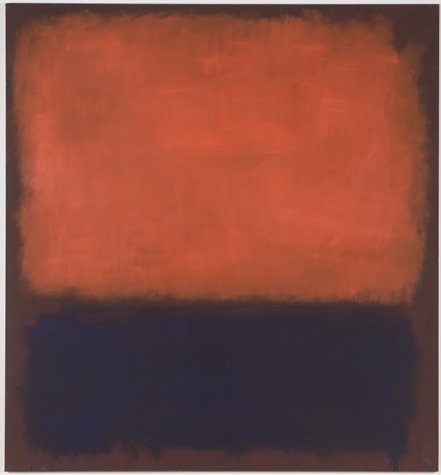 Description : Here, the fiery orange has a velvety texture, with light and heavy brushstrokes layered to create a luminous effect. Whereas the orange field seems to explode into the viewer’s space, the more uniformly applied twilight blue creates the sense of a receding vortex. The two colors are not formally balanced, but are also optical complements in the visual spectrum, contrasting and intensifying each other. Between these two extremes, the rich, warm eggplant background gently mediates the expansion and contraction of the other colors at then blurred perimeters. The grand scale of the canvas heightens the dramatic interplay even more forcefully. |
Mark Rothko, Rothko Chapel, 1964-1967, Texas, Houston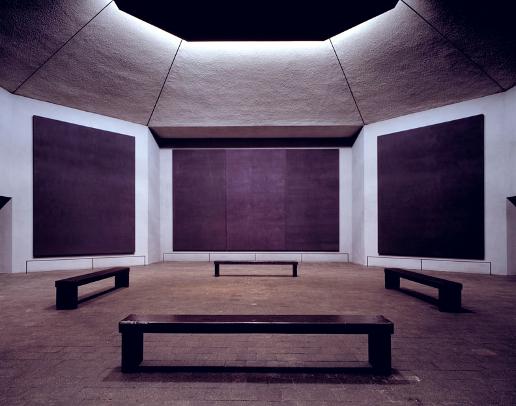 Description: The paintings executed in 1964 through 1967, by American artist, Mark Rothko, for the Rothko Chapel in Houston representing the fulfillment of the artist's lifelong ambition and a breakthrough in twentieth-century art. The Chapel commission allowed Rothko to determine the architectural setting and lighting in which the paintings would appear. On its walls are fourteen black, but color hued paintings. The shape of the building is an octagon inscribed in a Greek Cross, and the design of the chapel was largely influenced by the artist. The Rothko Chapel was well-known because it was the world's first broadly global center, a holy place opened to all religions and belonging to none.It became a center for international cultural, religious, and philosophical exchanges, and also performances.It is also a place of private prayer for individuals of all faiths. |
|
